
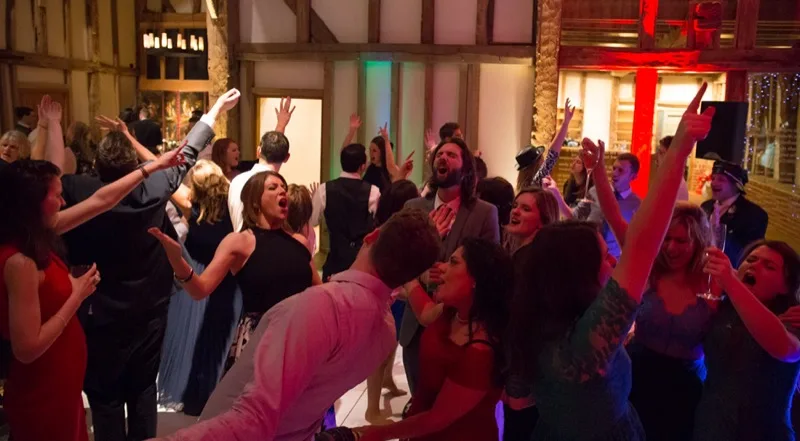
What you'll remember about your wedding is the moments, not the equipment: the song that got everyone up, the room singing together, the relative who never dances suddenly on the floor. Those come from someone reading the room, so when comparing DJs, ask how they'll handle your guests before asking what lights they bring.
I get it. You're comparing wedding DJs, and you want to know what you're getting for the money. So you ask what equipment they use, what lights they bring, whether a dance floor is included. It's a reasonable place to start.
The problem is, it's also where most couples stop.
And it's where the entire conversation goes sideways.
Why Do Wedding DJs Compete on Equipment?
Somewhere along the way, the wedding DJ industry decided that the best way to win a booking was to out-spec the competition. More lights. Bigger speakers. LED dance floors. Photo booths. Uplighting packages. Confetti cannons. Smoke machines. Some DJs list equipment the way restaurants list ingredients, as though the sheer volume of stuff should convince you it'll be good.
Scroll through a few DJ websites and you'll notice a pattern. The photos aren't of guests dancing or laughing or singing along. They're of equipment. Lights arranged in empty rooms. Dance floors photographed before anyone has stepped on them. It's like choosing a chef based on photos of their oven.
This arms race creates a strange dynamic. Couples end up comparing quotes line by line, trying to work out whether DJ A's uplighting package is better value than DJ B's LED dance floor. The conversation becomes entirely about stuff. And when everything is about stuff, the only differentiator left is price.
That's how a bespoke, personal service gets turned into a commodity. Like ordering office supplies.
Why Do Wedding DJ Quotes All Look the Same?
If you've requested quotes from several DJs, you've probably noticed how similar they sound. The packages have different names (Gold, Platinum, Ultimate, Premium) but the contents blur together. Lights, speakers, microphone, maybe a photo booth. Everyone promises a "great night." Everyone claims to "read the room."
When every option looks the same, your brain does the only logical thing. It picks the cheapest one. Or the most expensive one, hoping price equals quality. Neither approach tells you anything about how your wedding will actually feel.
I've spoken to couples who spent hours building spreadsheets comparing DJ packages. Columns for speaker wattage, number of lights, whether a mirror ball was included. Not a single column for "how will this person handle my nan who doesn't dance?" or "what happens if the speeches run 45 minutes over?"
Those are the questions that actually matter on the night. But they don't fit neatly into a comparison table.
What Will You Actually Remember in Ten Years?
Think about the best wedding you've ever been to. Not the most expensive. The one you actually enjoyed.
What do you remember about it?
I'll bet it wasn't the uplighting. It wasn't the speaker brand. It probably wasn't even the dance floor, unless someone did something memorably brilliant on it.
What you remember is moments. The song that got everyone up at once. The bit where the groom's dad, who never dances, was suddenly in the middle of the floor doing something that looked like it might have been the twist. The moment the whole room was singing the same line together and you could feel the energy shift from "nice evening" to "this is one of those nights."
Those moments don't come from equipment. They come from someone who knows which song to play at which moment, who's been watching the room for the last three hours, who noticed that the group by the bar haven't been on the floor yet and knows exactly what will pull them in.
That's a skill. You can't buy it in a lighting package. And you certainly can't compare it on a spreadsheet.
I've played weddings with no uplighting at all where the dancefloor was packed from nine o'clock until midnight. I've also seen weddings with thousands of pounds worth of lighting where the floor was empty by ten. The lights didn't make the difference. The person reading the room made the difference.
The Fifteen-Minute Test
Try this thought experiment. Take any wedding with fancy uplighting, an LED dance floor, and a smoke machine. Now remove all of it fifteen minutes into the evening. Just switch it off.
Would anyone notice? Maybe. For about thirty seconds. Then they'd go back to whatever they were doing, because the lights were set dressing, not the experience.
Now try the reverse. Take a wedding where the MC has been managing the timeline, coordinating with the venue, getting strangers talking to each other, reading the energy of the room and adjusting the music accordingly. Remove that person fifteen minutes in.
You'd notice immediately. The evening would drift. Nobody would know what's happening next. The dancefloor would empty and stay empty, because nobody's there to build the arc from first dance to last song. The venue coordinator would have questions and nobody to ask. The photographer would be looking for the person who's supposed to announce the cake cutting.
That's the difference between a commodity and a skill. One decorates the room. The other runs the evening.
What Does Experience-Focused Actually Mean?
When I say "experience over equipment," I don't mean I turn up with a laptop and a prayer. I bring proper kit. Professional sound, good lighting, reliable gear with backup systems that go three layers deep. The equipment matters. It's just not the thing that makes the difference.
The thing that makes the difference is what happens between booking and the last dance.
It's the Zoom call where I learn that the bride's parents are divorced and we need to handle the father-daughter dance with some sensitivity. It's knowing that the groom's best friend group will need indie rock at some point or they'll spend the evening at the bar. It's the love story narration I spend hours crafting from interviews with both of you, delivered to a room that has no idea what they're about to hear. It's knowing when to let the music breathe and when to push the energy up. It's the twenty-odd emails I send between booking and wedding day, each one helping you with a different aspect of the planning.
None of that appears on an equipment list. None of it fits in a comparison spreadsheet. But all of it shapes how your wedding feels.
What Should You Ask a Wedding DJ Instead?
If you're comparing DJs right now, put the equipment lists to one side for a moment. They're not irrelevant, but they're not where the decision lives.
Instead, ask these:
- How do you get to know us before the wedding? If the answer is "send me a playlist," that's a red flag. Your music taste is one small part of how your wedding should feel.
- What happens if the timeline shifts on the day? Because it will. Speeches run long. Photos take longer than expected. The venue needs extra time for the room turn. A good MC absorbs all of this without you noticing.
- How do you handle guests who don't dance? If the answer is "play something for everyone," that's not a strategy. That's a hope.
- What do you do between booking and the wedding? The gap between signing a contract and the big day is where care shows up. Or doesn't.
- Can you tell me about a wedding that didn't go to plan and how you handled it? Every experienced DJ has one. What they did about it tells you more than any equipment list ever will.
The DJ who answers these questions with specifics, with stories, with detail that could only come from doing this hundreds of times, is worth more than the DJ who answers them with a brochure.
What Are You Actually Buying When You Book a DJ?
When you book a wedding DJ, you're not buying speakers and lights. You're buying how your wedding feels. The difference between an evening that drifts and one that builds. The difference between a room full of people checking their phones and a room full of people who don't want to leave.
Equipment is necessary. Skill is what makes it matter.
The lights will look nice in the photos. The dance floor will be fun for a bit. But ten years from now, when you think about your wedding, you won't remember the wattage. You'll remember the feeling. The song. The moment.
That's the thing worth paying for.