
Music from your late teens and twenties hits harder because of the reminiscence bump: our most vivid memories cluster between roughly 15 and 25, and the songs from those years carry them. For every wedding, I map the ages of your guests so each generation hears its own era at the right moment.
You know that feeling when a track comes on and you're instantly 19 again? Not just "oh, I remember this song" but properly there, back in the car with your mates, at your first festival, in the club you used to go to every Friday. The hair on your arms stands up. You're singing before you even decide to.
That response isn't random. It's a well-documented psychological phenomenon called the reminiscence bump, and understanding it is one of the most powerful tools a wedding DJ has.
What Is the Reminiscence Bump?
If you asked a group of 50-year-olds to list their most vivid memories, most of those memories would cluster between the ages of roughly 15 and 25. Not childhood. Not last year. That specific decade when everything was new.
Psychologists call this the reminiscence bump. It happens because of how memory formation works during adolescence and early adulthood:
- Identity formation. This is the period when you're working out who you are. The music you discover during those years becomes part of your identity in a way that music from later periods rarely does.
- First experiences. First relationship, first job, first time living independently, first night out. Firsts create stronger memories, and this age range is packed with them.
- Heightened emotion. Everything feels more intense at 18 than at 38. The brain encodes emotionally charged experiences more deeply, and those years are full of emotional intensity.
- Peak cognitive encoding. The brain is particularly receptive during this period. Memory systems are working at their sharpest, forming connections that last decades.
Music is an especially strong trigger for the bump. Researchers sometimes call it the "musical reminiscence bump" because songs are so tightly bound to the memories they accompany. A track from your late teens doesn't just remind you of that time. It takes you there emotionally, in a way that a photograph or a conversation rarely can.
Why Does the Reminiscence Bump Matter on a Wedding Dance Floor?
A wedding guest list is a room full of different reminiscence bumps.
Your 28-year-old university friends? Their bump sits in the early 2010s: Calvin Harris, Rihanna, David Guetta. Your parents' friends in their late 50s? Their bump is late 1980s: Madonna, Prince, Whitney Houston. Your partner's grandparents? Early 1970s: Stevie Wonder, The Jackson 5, ABBA.
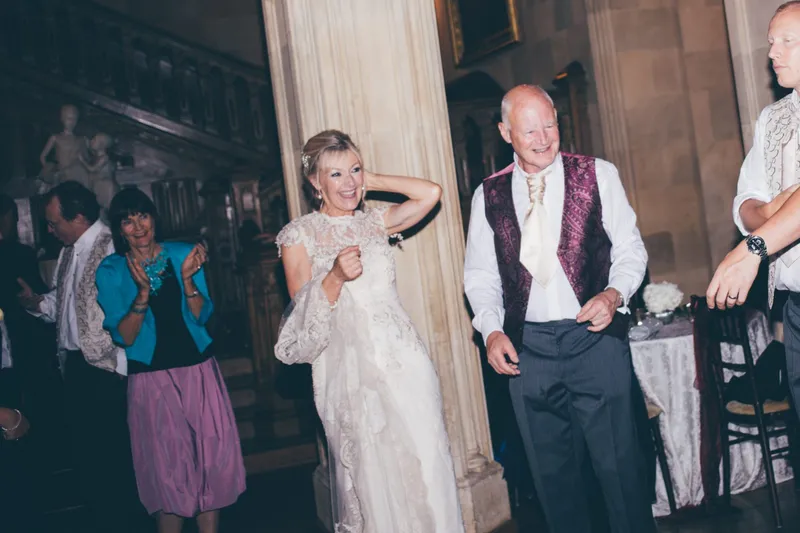
When a song from someone's bump comes on, you can see it happen. They don't just nod along. They light up. They grab their partner. They're on the floor before the chorus hits. It's involuntary, physical, emotional.
When a DJ plays a song that doesn't connect to anyone's bump in the room, you get polite swaying at best. The music might be technically great, current, well-mixed, but it doesn't trigger that visceral response because it doesn't carry anyone's personal history with it.
"Across the whole age range of family and friends, everyone said they enjoyed the music and atmosphere he created, and they were all impressed with how he read the crowd and played the right song at the right time."
-- Megan & Dean
How Do You Work Out the Reminiscence Bumps in the Room?
I work out the bumps in the room for every wedding, starting with your guests' ages, and it's not complicated once you know what to look for.
If most of your guests are between 30 and 35, their bump sits roughly around 2008 to 2015. That means the tracks that'll get the strongest emotional response will be from that era: Kings of Leon, Florence + The Machine, Arctic Monkeys, Beyonce, Daft Punk.
But your guest list isn't one age group. It's a spread. And the trick is mapping those overlaps.
Here's a rough guide:
- Guests aged 25-30 (bump: 2013-2020): Ed Sheeran, Mark Ronson, Dua Lipa, The Weeknd
- Guests aged 35-40 (bump: 2003-2010): Outkast, Usher, The Killers, Amy Winehouse
- Guests aged 45-50 (bump: 1993-2000): Oasis, Spice Girls, Backstreet Boys, Destiny's Child
- Guests aged 55-60 (bump: 1983-1990): Michael Jackson, Prince, Cyndi Lauper, Whitney Houston
- Guests aged 65+ (bump: 1975-1985): Bee Gees, Donna Summer, Earth Wind & Fire, Chic
When I know the age spread, I can build a set that hits multiple bumps across the evening. Not a medley. Not a "something for everyone" checklist. A genuine flow that moves between eras in a way that feels natural, where each generation gets their moment without anyone else feeling like the music has left them behind.
This is what reading the room actually looks like in practice. Not just watching who's dancing, but understanding why certain tracks land harder than others with specific groups of people.
Why Does a 50th Birthday Party in 2026 Need Early House and Hip-Hop?
The reminiscence bump isn't just a wedding principle. It applies to any celebration where music is the centrepiece.
Someone turning 50 in 2026 was born in 1976. Their reminiscence bump sits between 1991 and 2001. That's the era of early house music, Britpop, garage, R&B, and the first wave of mainstream hip-hop. Not the golden oldies that a lazy DJ might default to.
Someone turning 60? Born in 1966, bump sitting around 1981-1991. Early Madonna, Wham!, New Order, Pet Shop Boys. The decade that defined electronic pop.
The point is that "age-appropriate music" doesn't mean what most people think it means. A room full of 50-year-olds doesn't want 1960s rock and roll. They want the music that was playing when they were falling in love, making friends, and finding out who they were. And that's a completely different playlist.
How Do I Use the Reminiscence Bump When Planning Music with Couples?
One of the first things I ask couples about is their guest list, not just numbers but the age spread, the mix of groups, where people are coming from. That information tells me as much about the music I'll play as the couple's own preferences do.
Your favourite tracks matter, of course. But your guests are the dance floor. If I can hit their reminiscence bumps at the right moments, the floor fills itself. People don't need to be told to dance. The music does the work because it's triggering something deeper than preference. It's triggering memory, identity, and emotion.
That's what it looks like when a DJ is doing more than just playing good music. They're reading the room at a psychological level, connecting people to the parts of themselves that are most open to joy.
"What a celebration! Tony helped the day flow smoothly whilst maintaining this wonderful sense of joy throughout. ... Our diverse group of friends and family members, from university mates to work colleagues, all felt included and connected, and Tony was really instrumental in creating that inclusive atmosphere."
-- Lucy & Stuart
And that's the bit that can't be replicated by a playlist. A playlist plays songs. A DJ plays people.
If you'd like to talk about the music for your wedding, get in touch. I'd love to hear about who'll be in the room.