
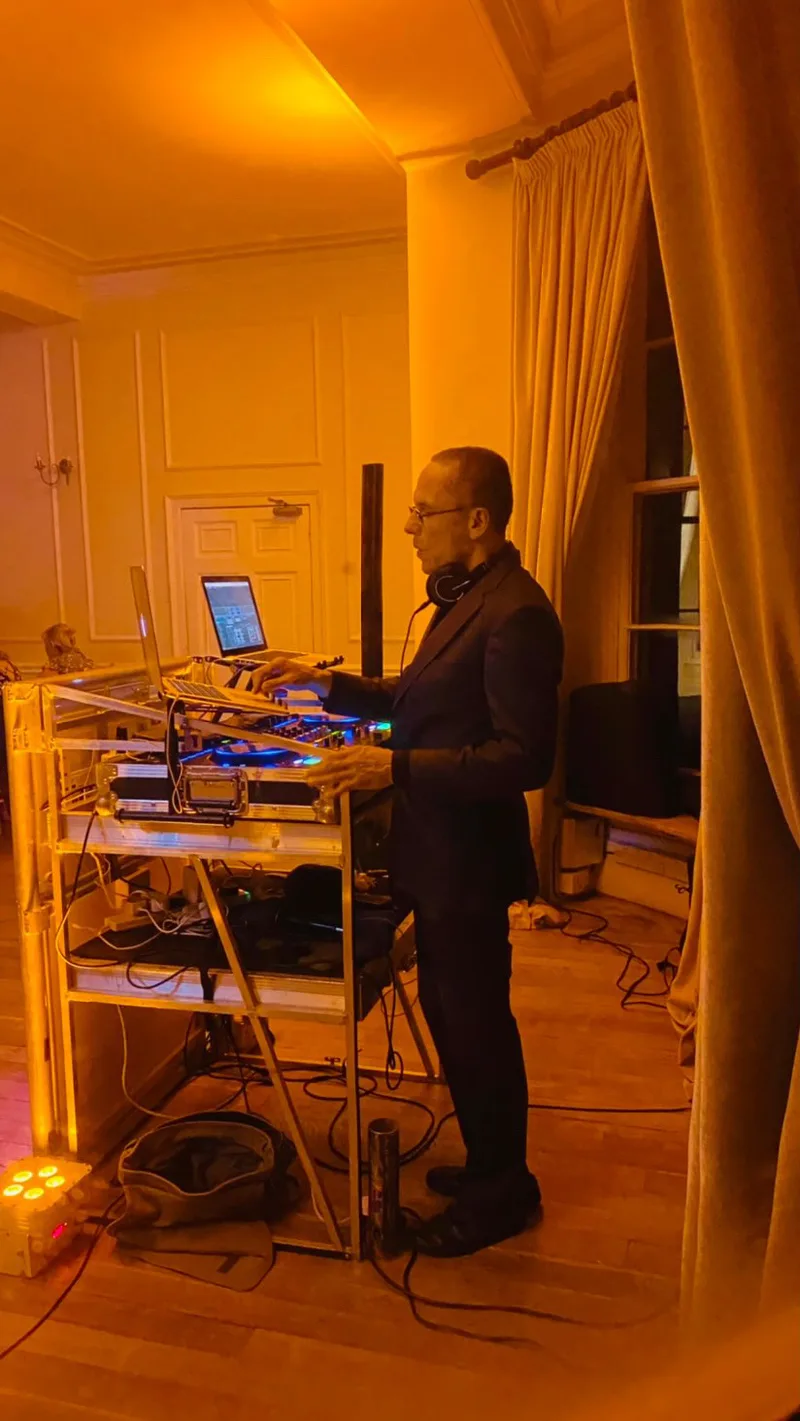
The best wedding DJs look boring because the work is invisible: they're watching your guests, lining up the next tracks and adjusting the energy instead of performing. A calm DJ keeps you and your guests relaxed. After more than 2,500 weddings, I know the foreground belongs to you, your partner and your guests.
If you walked past the DJ booth at the best weddings I've ever played, you'd see a bloke standing quietly behind a pair of decks. No jumping. No fist-pumping. No microphone. Just someone staring at a crowd of people who seem to be having the time of their lives.
You'd be forgiven for thinking he wasn't doing much.
That's exactly what it should look like.
Why Doesn't a Performing DJ Work at a Wedding?
There's a version of DJing where the DJ is the show. You've seen it: hands in the air, "make some noise!", spinning around, climbing on the booth, the whole performance. It works in clubs. It works at festivals. It absolutely does not work at a wedding.
The reason is simple. In a club, people came to see the DJ. At your wedding, nobody came to see the DJ. They came to celebrate you. The moment a DJ makes themselves the centre of attention, something shifts. Your guests start watching the performance instead of being in the moment. The dancefloor becomes an audience, not a party.
I learned this the hard way. I spent 12 years DJing in clubs abroad, across 14 countries. Japan, Norway, Switzerland, Hong Kong, Spain. In those rooms, the energy between DJ and crowd is a two-way thing. You feed off each other. The bigger you go, the bigger they go. It's intoxicating.
Then I started DJing weddings, and I realised that everything I'd learned about commanding a room needed to be turned inside out. A wedding doesn't need commanding. It needs conducting.
What Is a Wedding DJ Watching While the Music Plays?
People say "reading the room" like it's a single skill. It isn't. It's about 15 things happening at once, and none of them involve the music that's currently playing.
Right now, at this moment during your wedding, I'm watching:
- The group near the bar who've been standing with their drinks for two songs. Are they resting or have they lost interest?
- Your nan, who was tapping her foot during the Motown set but sat down when the tempo jumped. She'll be back if I bring it down a notch in two tracks' time.
- The cluster of blokes near the entrance who haven't been on the floor yet. They're waiting for something specific. Probably rock or indie. I've got three tracks loaded that I think will pull them in.
- The bride's friends who've been dancing solidly for 40 minutes. They need a breather, even if they don't know it yet. A slower track now means they'll be back for the peak.
- The energy gap that always happens around half nine when the evening guests arrive and the day guests go to the bar. I've got a plan for that transition because I've managed it 2,500 times before.
All of that is happening behind a face that looks like it's doing nothing. Because if I looked stressed, you'd feel stressed. If I looked like I was scrambling to find the next track, you'd wonder if something was wrong. The calm is the job.
Why Does a Calm DJ Make for a Better Wedding?
Your wedding day is the most emotionally exposed you'll ever be in a room full of people. You're already nervous about the speeches, the first dance, whether everyone is having a good time. The last thing you need is a DJ who looks like he's having his own crisis behind the decks.
When the DJ is calm, the couple is calm. When the couple is calm, the room relaxes. When the room relaxes, people dance. It's a chain reaction, and it starts behind the booth.
I've seen what happens when it goes the other way. A DJ who's visibly flustered, who's talking into the mic too much, who's trying too hard to generate energy by force. The room tightens. Guests become self-conscious. The dancefloor thins out. And the couple, who are already dealing with a hundred emotions, now have to worry about whether the entertainment is going wrong.
I never want to be another thing you have to worry about. That's the whole point.
What Happens in 30 Seconds Behind the Decks?
From the outside, it looks like standing and pressing play. From behind the decks, here's what a typical 30 seconds looks like:
The current track has about 90 seconds left. I've already selected the next track and the one after that. I'm adjusting the EQ on the incoming track because it's heavier on the bass than the outgoing one, and if I don't pull it back the transition will feel muddy. I'm checking the running order to see if the cake cutting is still at 9.15 or if the photographer has pushed it back. I'm watching the group on the right who've just ordered a round of shots. They're about to go up a level, so I need to match that in two tracks' time. The bride's dad just walked past the booth and gave me a thumbs up, which tells me the older guests are happy. I've got a Stevie Wonder track cued up that I think will bring the mums back onto the floor after the next transition.
That's 30 seconds. It's not silence behind the decks. It's the opposite. It's constant, focused decision-making that nobody should ever see.
The Fourteen-Country Education
When I was DJing in clubs, I played for crowds who spoke different languages, danced to different rhythms, and had completely different ideas of what a good night sounded like. A set that killed it in a London club would fall flat in Japan. A tempo that worked in Norway would clear the floor in Spain.
What that taught me is that music is only half the equation. The other half is the people in front of you, right now, in this room, at this moment. Not the people you expected. Not the playlist you prepared. The actual humans standing on the actual dancefloor, and what they need from the next three minutes of music.
That's not something you learn from a DJ course. It's something you develop over thousands of hours of watching people respond to sound. And the observation that makes it work is invisible. You watch, you adjust, you watch again. Nobody notices because there's nothing to notice. The music just seems to fit.
Why Is a "Boring" DJ a Good Sign?
The best compliment I've ever received after a wedding wasn't about the music. It was a bride who said: "It felt like the night just happened. Like it was all meant to be."
That's what invisible work looks like. She didn't notice the transitions because they were seamless. She didn't notice the tempo shifts because they matched the room. She didn't notice the moment I pulled back the energy to give people a breather because it felt natural. She definitely didn't notice the five adjustments I made to the running order when the speeches overran by 25 minutes.
If she'd noticed any of that, I'd have failed.
The DJs who look boring are the ones who've done the work beforehand. They've planned the dancefloor arc. They've studied the five-list music system. They've coordinated with the venue and the photographer. They've tested the first dance track twice. By the time the party starts, the preparation is done, and all that's left is the reading.
Reading a room is quiet work. It's the opposite of performance. And it's the hardest skill in DJing to develop, because nobody teaches it, nobody sees it, and the only way to learn it is to do it thousands of times until it becomes instinct.
What One Question Should You Ask Your DJ?
If you're looking for a wedding DJ, ask them this: "What do you do when the dancefloor starts thinning out?"
If they say they grab the mic and try to hype the crowd, that tells you something. If they say they watch what's happening, adjust the music, and wait for it to rebuild, that tells you something different. A good wedding MC speaks when there's something worth saying and stays quiet the rest of the time.
Neither answer is wrong. But one of them means the DJ is going to be part of the background of your evening, reading every shift and responding to it. And the other means they're going to be part of the foreground.
At your wedding, the foreground should be you, your partner, your family, and your friends. The music should feel like it was always there, like nobody chose it, like the night simply unfolded the way it was meant to.
That's what boring looks like from the outside. And it's anything but.
Want to understand more about how I approach the music? Read about letting the music breathe, the art of song selection, or why a great DJ can make or break your wedding. And if you're wondering whether demo mixes are a reliable way to judge a DJ, they're not.