
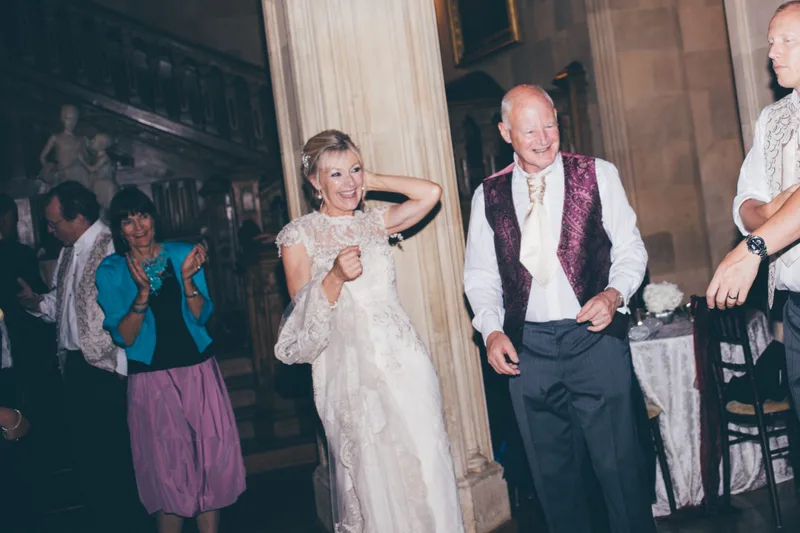
The most requested wedding songs are singalong crowd-pleasers led by ABBA's 'Dancing Queen', Queen's 'Don't Stop Me Now' and Neil Diamond's 'Sweet Caroline'. They show that your guests want to sing together, whatever their age. After more than 2,500 weddings, I've found that when and how a song plays matters more than which songs make the list.
Every wedding DJ gets asked some version of the same question: "What are the most popular songs at weddings?" It is a fair question. You want to know your dancefloor will work, and a list feels like a safe starting point.
But here is what I have learned after 2,500+ weddings: the list is only half the story. How and when these songs get played matters far more than which ones make the cut.
What Are the 20 Most Requested Wedding Songs?
Based on a national poll and cross-referenced against requests I receive year after year, these are the songs that keep coming back:
- "Dancing Queen" by ABBA
- "Don't Stop Me Now" by Queen
- "Sweet Caroline" by Neil Diamond
- "Happy" by Pharrell Williams
- "Mamma Mia" by ABBA
- "Oh What a Night" by Frankie Valli
- "Dancing in the Moonlight" by Toploader
- "Night Fever" by Bee Gees
- "I Gotta Feeling" by Black Eyed Peas
- "Don't Stop Believin'" by Journey
- "I'm Still Standing" by Elton John
- "Mr Brightside" by The Killers
- "Livin' on a Prayer" by Bon Jovi
- "Can't Stop the Feeling" by Justin Timberlake
- "Signed, Sealed, Delivered" by Stevie Wonder
- "Let Me Entertain You" by Robbie Williams
- "Believe" by Cher
- "How Will I Know" by Whitney Houston
- "Single Ladies" by Beyonce
- "Uptown Funk" by Mark Ronson ft. Bruno Mars
Look at that list for a moment. It spans five decades. The oldest track is from 1967 and the newest from 2016. What they all share is singability, a strong beat, and the ability to get people of any age on their feet.
Why Do These Songs Keep Working at Weddings?
There is a reason these tracks survive while others fade. It is not just nostalgia, though that plays a part. These songs work at weddings because they do three things at once:
They are communal. Everyone knows the words, or at least the chorus. That shared knowledge turns a room of individuals into a group doing the same thing together. When 100 people sing "Sweet Caroline" with their arms round each other, the song is not really the point any more. The togetherness is.
They cross generations. A 25-year-old and a 65-year-old both know "Don't Stop Me Now". They know it from different contexts, maybe a school disco and a film soundtrack and a retirement party, but they both know it. These songs act as bridges between age groups who might otherwise stay in their own corners.
They give permission. Some guests need a signal that it is OK to dance. A song they know well, one with a clear beat and a familiar structure, is that signal. It lowers the barrier. Nobody feels silly dancing to "Dancing Queen" because everybody else is doing it too.
This is closely connected to the reminiscence bump, the psychological principle that music from your formative years (roughly ages 15 to 30) triggers the strongest emotional responses. A room with guests spanning 25 to 70 has multiple "bumps" running simultaneously. The songs above tend to sit in several people's bumps at once.
"...he played a very good selection of tunes that got our guests from many nationalities to have a wonderful time on the dance floor. People in their 60s and 70s were dancing along with people in their 30s!"
-- Paolo & JC
What Does a Song List Not Tell You?
The biggest thing a list cannot tell you is how to sequence the songs. If you handed this list to a DJ and said "play these in order", you would not get a great dancefloor. You would get a karaoke session that peaked at song three and fizzled by song ten.
The reason is sequencing. Playing four high-energy anthems back to back exhausts people. Playing two slow-builders in a row loses momentum. The art is in the gaps between songs: what comes before "Mr Brightside" matters as much as the song itself.
A list also cannot tell you when your crowd is ready. "Livin' on a Prayer" at 8pm when the floor is half empty is background noise. The same song at 10:30pm when everyone is warm and the energy is climbing? That is a moment people remember.
Context, timing, and energy management are what turn a playlist into a dancefloor experience. That is the difference between pressing play and reading the room.
What If Your List and Your Guests' Requests Do Not Match?
Something I see regularly: a couple sends me their dream playlist, carefully curated to reflect their tastes. Indie. Alternative. Deep cuts. They are excited about it, and so am I.
Then the requests start arriving from guests. "Can you play 'Mr Brightside'?" "We'd love some ABBA." "Any chance of 'Don't Stop Me Now'?"
This is not a problem to solve. It is information to use. Those guest requests tell me what will fill the floor. Your curated list tells me who you are. My job is to weave both together so the night feels like you but also gives everyone their moment.
The couples who have the best dancefloors are usually the ones who share their favourites, flag their do-not-plays, and then trust me to mix their personality with their guests' energy. Not a rigid playlist. Not a free-for-all. Something in between.
"The set up is very simple and you get to guide him in advance on his website of what type of music you want, choosing some songs that have to be played, some songs that you would like played and you leave the rest up to him."
-- Lucy & Paul
How Should You Use a Wedding Songs List?
If you are in the early stages of thinking about wedding music, here is how to get the most from a list like this:
Use it as a starting conversation, not a final answer. Scan the list with your partner. Which songs make you both smile? Which ones make you groan? That reaction is useful data for your DJ.
Think about your guest mix. What ages are in the room? If you have got a strong contingent over 50, songs from the 70s and 80s matter. If most guests are under 35, the newer end of this list and beyond will carry more weight.
Do not overthink the do-not-play list. A handful of genuine no-go songs is fine. A list of 40 banned tracks usually means you are trying to control something that works better with flexibility.
Remember: these songs are not compulsory. Some weddings never need "Sweet Caroline". Others live on it. There is no universal formula because there is no universal crowd.
If you want to talk through what your crowd actually needs, not just what is popular in general, get in touch. We will map your guest mix, your favourites, and your boundaries, and build a plan that feels completely yours.