
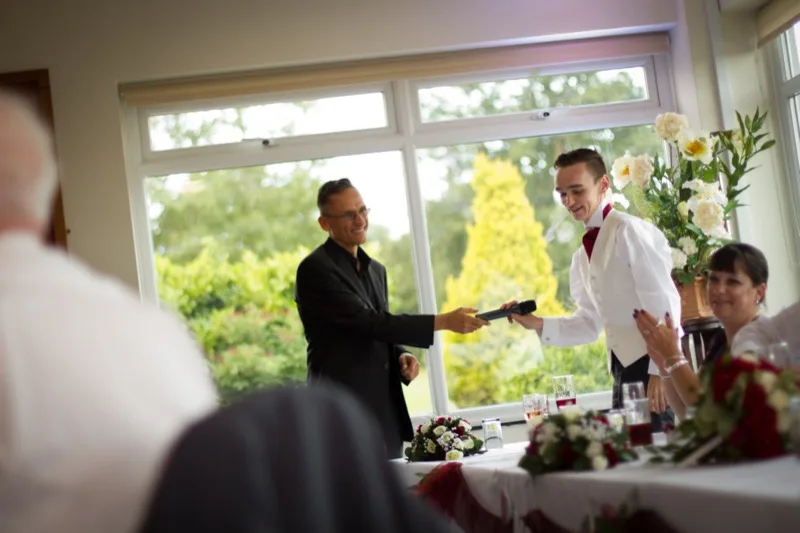
When the plan falls apart, your MC fixes it before you find out: reseating unexpected guests, adjusting timings with the chef, settling a nervous best man. At one wedding I gave up my own plate. That hidden work is about seventy percent of what I do at a wedding, and most couples never see it.
What Happens When Evening Guests Arrive for the Ceremony?
The ceremony was about to begin. Everything was in place. The timeline was set, the venue was ready, the couple were minutes away from saying their vows. And then two guests walked in who weren't supposed to be there.
They'd been invited to the evening reception only. But they'd come from a country where the concept of "evening guests" simply doesn't exist. In their culture, an invitation to a wedding means you come to the whole thing. The time printed on the invitation looked like an error, so they'd arrived early. They'd done nothing wrong. They just didn't know.
The bride noticed immediately. Her face shifted from happy to worried in about half a second. There wasn't enough food for extra guests at the sit-down meal. Their names weren't on the table plan. And she didn't have the heart to explain the misunderstanding to them, not on her wedding day, not to people she genuinely cared about.
That worry would have sat with her through the ceremony, the photos, the meal, and into the evening. It would have coloured the whole day. Unless someone dealt with it.
How Did I Fix It Without the Bride Knowing?
I sorted it in minutes, while the photographer took the couple outside for their shots. A couple of guests who'd accepted the invitation had cancelled at the last minute (as happens at nearly every wedding), which meant there were spare places at the meal. The food issue was solvable.
I found the head chef and the catering manager. We had a quick conversation. They adjusted the covers. I rearranged the seating to accommodate the extra guests naturally, so it wouldn't look like a last-minute fix. When the unexpected guests asked why their names weren't on the table plan, I told them it was a printing error. They sat down, ate their meal, and enjoyed the evening.
I gave up my own plate that day. It's not the first time. When the numbers are tight and someone needs to eat, the person who can skip a meal without anyone noticing is me.
The bride still doesn't know any of this happened. She went from worried to relaxed during the photos, assumed someone had sorted it, and got on with enjoying her wedding. That's exactly how it should work.
What Else Goes Wrong Behind the Scenes at a Wedding?
Unexpected guests are just one story from one wedding. I've got dozens.
The supplier who didn't show up and needed replacing with a phone call and a favour. The guest who had too much to drink and needed steering away from the dancefloor before it became a scene. The mother of the bride who was in tears in the corridor and needed five minutes of quiet reassurance before she could walk back in. The cake that started leaning during the speeches and needed propping up with cocktail sticks before the cutting photos.
I've coordinated with chefs when the timeline shifted by an hour because the ceremony ran long. I've reorganised a room layout on the fly because a supplier delivered the wrong size dance floor. I've found extra chairs for guests who arrived with partners nobody knew about. I've managed the awkward moment when a guest turns up to the ceremony wearing the same outfit as a bridesmaid. None of these are in my job description. All of them are in my actual job.
None of these appear in the wedding album. None of them get mentioned in the speeches. Most of them never reach the couple at all. That's the point.
A wedding day generates problems the way a kitchen generates washing up. Constantly, invisibly, and if nobody deals with them, eventually everything grinds to a halt.
Most of these aren't crises. They're small things. A timeline that needs nudging. A guest who's lost. A supplier who needs a decision and the couple are busy having photos taken. Individually, each one takes thirty seconds to solve. But if nobody's solving them, they pile up. And a pile of small unsolved problems starts to feel, to the couple, like something is off about the day. They can't pinpoint what. They just sense that things aren't quite flowing.
The question isn't whether something will go wrong. Something always goes wrong. The question is whether someone is watching for it, ready to fix it before it reaches the couple.
Why Is Your MC Your First Responder on the Day?
Your MC is the person guests and suppliers turn to when something goes wrong, even though many couples assume the venue coordinator handles every problem. And venue coordinators are brilliant. But their job ends at a certain point. They manage the building, the staff, and the catering. They don't manage the people.
When a guest has a problem, they don't go to the venue manager. They look for the person with the microphone. When the photographer needs to know if the speeches are running long, they come to me. When the florist has a question about where the centrepieces go after the room turn, they ask me. When the father of the bride wants to know if he should mention the groom's late mother in his speech, he pulls me aside during the drinks reception.
An MC sits at the intersection of every moving part. The couple, the families, the venue, the caterers, the photographer, the band or DJ, the guests. Everyone's timeline connects through one person. If that person is paying attention, problems get caught early and fixed quietly. If nobody's in that role, problems grow until they're visible to everyone.
The crisis management is the most unseen part of what an MC does. It's also, arguably, the most valuable. You'll never know what your MC prevented, and that's the whole point.
What's the Difference Between a Wedding DJ and a Host?
A DJ plays music. A good DJ reads the room and plays the right music. But neither of those roles involves coordinating with the chef when the timeline shifts, or breaking the ice between two tables of strangers, or quietly removing a broken glass from the dancefloor while making it look like you were just walking past.
The gap between a DJ and a host is the gap between playing a soundtrack and owning the evening. One reacts to what's happening. The other anticipates what's about to happen and shapes it before anyone notices.
When couples ask me what I actually do at their wedding, the honest answer is: the bit you see is maybe thirty percent of it. The announcements, the music, the love story narration. That's the visible part. The other seventy percent is watching, listening, coordinating, adjusting, and solving problems that you never knew existed.
I've had photographers pull me aside to say "speeches are going to overrun, should I stay?" I've had caterers ask me to stall the room for ten minutes because the main course isn't ready. I've had best men come to me in a cold sweat asking for last-minute speech advice. All of these conversations happen while the couple are laughing with their guests, completely unaware that the machinery of their day is being adjusted in real time.
If I've done my job properly, your memory of the day is uninterrupted joy. No friction. No awkward silences. No moments where you thought "what's supposed to happen next?" Just a day that flowed.
Making It Personal, Not Just Professional
Crisis management is one side of hosting. The other is making people feel like they belong.
One of my favourite parts of the day is introducing the wedding party. Not just their names and titles, but who they actually are. Not "Here's Sarah, the Maid of Honour," but something like:
"This is Sarah. She's known the bride since Year 8, once helped her dye her hair pink, and is the reason they both still laugh when someone says 'Magaluf.'"
It gets the room laughing and instantly makes people feel like insiders, even the guests who've never met Sarah. That's the same principle as the Love Story: when I narrate how the couple met, both sides of the room start to feel connected to a story that isn't theirs. And that connection changes everything about the atmosphere for the rest of the evening.
As one couple put it:
"Planning a wedding can be a whirlwind of decisions, but one choice we are forever grateful for is having Tony Winyard as our wedding DJ and Master of Ceremonies."
-- Ellie & Simon
The Things You'll Never Know About
I sometimes think about telling couples, afterwards, about all the things that went on behind the scenes. The near-misses. The quiet fixes. The conversation with the venue manager that prevented a twenty-minute delay. The guest situation that could have become awkward but didn't.
But I never do. Because the whole value of the fix is that it was invisible. Telling the couple about the problems would just retroactively add stress to a day that felt effortless. And effortless is the goal.
Your wedding day should feel like the simplest, most natural thing in the world. Like everything just happened to fall into place. Like every transition was smooth, every moment was timed right, and every potential problem simply didn't materialise.
The water was quite unaware of how wet it was. And that's exactly how a wedding should feel. You shouldn't be thinking about the mechanics. You should just be in it.
Behind the scenes, someone was making sure of that. You just didn't notice. Which means they were doing it right.