
At my worst wedding, around 2005 in Richmond, my computer crashed at least fifteen times. Years later, a groom left me a one-star review after a family member arrived nearly three hours late and the timeline collapsed. The first taught me to build backups for my backups; the second, to meet every couple before accepting a booking.
What Happened at My Worst Wedding?
It was around 2005, at a venue in Richmond. I was using a Windows desktop computer to run my music. State of the art at the time. Expensive. I'd been using it for a couple of years without a single problem. It was the backbone of my setup and I trusted it completely.
That night, it decided to stop working.
The blue screen of death appeared for the first time during the dancing. The music stopped dead. Complete silence. A room full of people mid-step, looking around, wondering what had happened. I rebooted. Computers were slower then, so "rebooting" meant minutes of staring at a loading screen while the dancefloor stood empty and the energy drained out of the room.
It came back. The music started again. People drifted back to the floor. Then it crashed a second time.
And a third. And a fourth. And a fifth.
At least fifteen times that evening, the screen went blue, the music died, and I was left standing behind a dead machine trying to get it running again while the guests stared at me. The first few crashes were awkward. By the tenth, they were angry. By the fifteenth, the evening was destroyed.
It was the worst wedding I've ever done.
I drove home that night and couldn't sleep. I replayed the evening over and over. The faces of the guests. The frustration. The couple's day, ruined by something I should have been able to prevent. I'd trusted a single piece of equipment with no fallback, no plan B, nothing. And when it failed, I had nothing to offer except apologies and a loading screen.
Why Did a Groom Leave Me a One-Star Review?
Years later, a different wedding. A different kind of failure.
I'd been booked for a wedding in Oxfordshire. I'd met the couple multiple times in the build-up, probably three or four meetings over the course of a year. I'd put in hours of preparation. A love story narration. Wedding party introductions. Carefully curated playlists. The bride's sister wanted specific sound effects played at certain moments during the ceremony. I'd planned everything down to the detail.
On the day, a close family member arrived nearly three hours late for the ceremony.
The registrars were furious. They had another wedding to get to. The chefs were angry because the food had been timed to perfection and was now sitting in a holding pattern. Everything started cascading. The ceremony was delayed. The meal was delayed. The entire timeline collapsed like a row of dominoes.
Normally, the love story narration happens at the beginning of the wedding breakfast. There was no time. I thought perhaps I could deliver it later, after the meal. But the meal ran so long that by the time everyone finished eating, it was already around nine o'clock. The wedding was finishing at midnight. The photographer was livid because they should have left hours earlier. The venue was under pressure.
There was no window for the love story. No time for the Mr and Mrs game. No opportunity for any of the things we'd spent a year planning together. We went straight into the first dance because we had to. And because the guests had literally just finished eating, almost nobody was ready to dance.
A few days later, the groom left me a one-star review on Google. He blamed me for the evening. For the atmosphere. For the fact that not enough people danced. He didn't mention the three-hour delay. He didn't acknowledge the chaos that his family had caused. He put it all on me.
I never replied. If someone can watch their own family derail an entire day and then point the finger at the DJ, there's no conversation to be had. The review still stings. But it taught me something more valuable than any five-star review ever has.
Were There Warning Signs Before the Wedding?
Looking back at that wedding, the signs were there long before the day itself.
During the build-up, I'd started getting uncomfortable. The requests were escalating. More demands, more stipulations, some of which didn't quite make sense. Sound effects that had no clear purpose. Requirements that kept changing. A general feeling that this couple's expectations and reality were drifting apart.
I'd had a gut feeling. A quiet voice saying "this one might be difficult." I've learned to listen to that voice. At the time, I hadn't.
I've always been careful about which bookings I accept. After that experience, I became far more careful. That nagging feeling during the preparation, the one I chose to ignore, was my instinct telling me something that my professionalism was overriding. "You can make this work" is not the same as "this is going to work."
What Happens If Your DJ's Equipment Fails?
The Richmond disaster changed everything about how I set up for a wedding. I swore I would never again be standing in front of a dead machine with nothing to fall back on.
Today, my setup has so many layers of redundancy that I sometimes lose count.
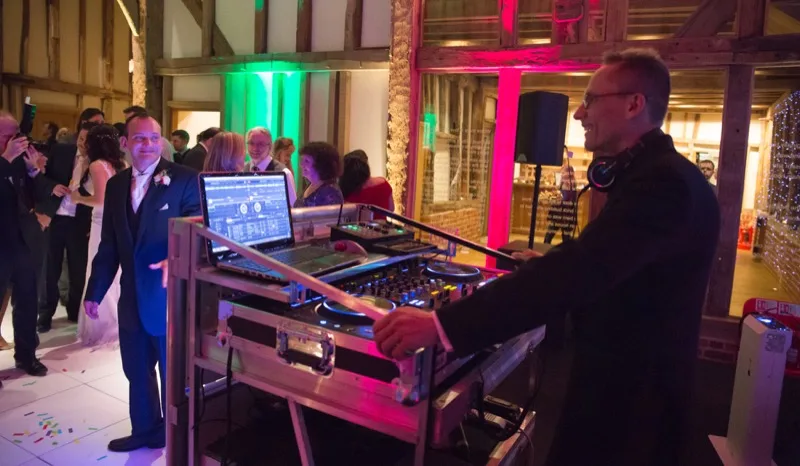
My main MacBook runs the music through a Pioneer controller into two Bose speakers. If the MacBook has a problem, I have a second, older MacBook connected to the same controller, ready to take over. If the controller itself fails, I can go straight from either MacBook into the speakers, bypassing the controller entirely.
If both MacBooks somehow failed (which has never happened, but Richmond taught me to plan for "never"), I carry an iPad loaded with many gigabytes of music and around fifty pre-built playlists covering every genre and era. My iPhone has the same. Either device can connect directly to the speakers.
The two Bose speakers are independent of each other. If one goes down, the other keeps playing. And in the van, always, there's a battery-powered speaker. I can run music from any device, through that speaker, without needing a single socket of venue power.
Even if the venue lost power entirely (it happens; I've been at marquee weddings where generators have failed), I could keep playing music from a MacBook or iPad running on battery, through a battery-powered speaker, for hours.
Is this overkill? Probably. But the best DJs look like they're not doing much, and part of that calm comes from knowing that there is no realistic scenario where the music stops and doesn't come back within seconds.
Richmond gave me that. Not in a good way. But permanently.
Why Do I Meet Every Couple Before Accepting a Booking?
The one-star review changed something different. Not my equipment. My process.
I now meet every couple before accepting a booking, usually over Zoom. Couples think this meeting is purely for them to decide whether they want to book me. It isn't. It's also for me to decide whether I want to take the booking.
I'm listening for the things that don't get said. The couple who can't agree on anything during the call. The client who treats the conversation like a negotiation rather than a collaboration. The requests that keep expanding without any sense of proportion. The feeling, hard to articulate but impossible to ignore, that this wedding is going to be difficult for reasons that have nothing to do with music or logistics.
There have been a couple of occasions where I've decided, after the meeting, that it wasn't right. When the couple contacted me to go ahead, I told them the date had been taken by someone who'd enquired earlier. A polite exit that protects everyone.
This might sound precious. It isn't. It's protection for the couple as much as for me. If I'm not confident that we're a good fit, the wedding won't be as good as it should be. Better to say no early than to deliver something below the standard I hold myself to.
I'd rather do fewer weddings brilliantly than more weddings adequately. The couples I work with get everything I have. That only works if I'm selective about who those couples are.
The Difference Between a DJ Who Has Failed and One Who Hasn't Yet
Every wedding DJ who has been doing this long enough has a worst night. A story they don't put on their website. A review that still sits in their stomach years later. An evening they'd give anything to do over.
The question isn't whether your DJ has ever had a bad night. The question is what they built because of it.
Did the failure make them better? Did they go home and redesign their entire setup so it could never happen again? Did they change their process, their preparation, their criteria for taking a booking? Or did they just move on and hope it wouldn't happen twice?
I can't undo Richmond. I can't undo that one-star review. But I can tell you that every wedding I've done since has carried the lessons from both. The backup chain that goes five layers deep. The preparation process that starts months before the day. The instinct, hard-earned, to recognise when something isn't right and to act on it rather than ignore it.
More than two and a half thousand weddings have taught me a lot. But those two nights taught me the most. Not because they went well. Because they didn't.