
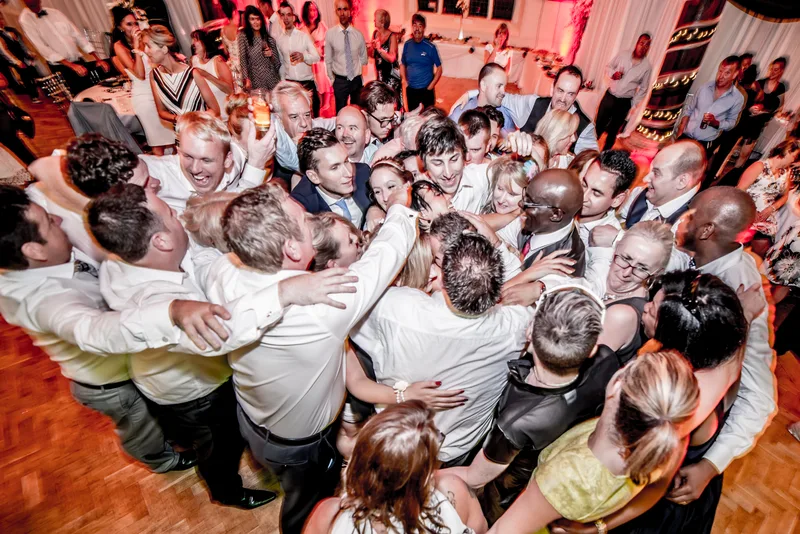
Choose a wedding DJ who asks about you, communicates easily, offers a proper planning meeting, adapts on the night, and brings backup equipment and a written contract. Their kit and demo mixes matter far less. After more than 2,500 weddings, my final test is simple: after one conversation, do you trust them?
Most couples spend weeks choosing flowers, table linens, and stationery. The DJ booking often happens in an afternoon.
That's understandable. But it creates a problem. Because your wedding DJ shapes the energy and flow of your entire evening. Not just the music, but the announcements, the timing of the first dance, the transitions between courses and speeches, the momentum that keeps guests on the dancefloor at 11pm instead of slipping off to the bar at 9.
And the thing that makes this decision feel difficult isn't the music. It's the fear. Will they be cringeworthy? Will they talk too much? Will the dancefloor empty? Will it be worth the money?
Those fears are worth taking seriously. Because the difference between getting this right and getting it wrong is the difference between guests saying "that was the best wedding I've been to" and a room that loses its energy before the second set starts.
"There were 4 weddings from my friend group this summer, and ours was by far the best."
What Does "Getting It Right" Feel Like?
Before we talk about what to look for, it helps to know what you're aiming for. Not in terms of equipment or playlists, but in terms of how the evening feels.
"Tony was such a reassuring presence before and during our big day. He's warm, confident and without a hint of arrogance or ego."
"He arrived with clear ideas about how to structure the day, confident in his music choices, assured in his MC delivery. But his confidence never tipped into arrogance, he was collaborative and open to our input."
Notice what these couples describe: how they felt. Safe. Calm. Confident that someone else had it covered. Not impressed by a spec sheet. Not wowed by lights. Just relieved that the person in charge of their evening actually knew what they were doing and cared about getting it right.
That's the outcome you're looking for.
What Should You Look For in a Wedding DJ?
Not all experience is equal. A DJ who's spent ten years doing corporate events and 18th birthday parties isn't automatically the right fit for a wedding. Weddings have their own rhythm, their own emotional shape, and they need someone who understands that.
Here's what actually matters:
- They ask about you. Not just your date and venue. About your taste, your guests, the vibe you want, the songs that mean something to you. A DJ who's more interested in your celebration than in selling their services is a DJ who'll get the evening right.
- Communication feels easy. Replies are prompt, thoughtful, and clear. You don't feel chased or pressured. You feel looked after.
- A proper planning process. You should expect at least one detailed conversation (ideally a video call or in-person meeting) before the wedding. If a DJ is happy to just turn up with a playlist and wing it, that tells you everything.
- Flexibility. Your wedding isn't a nightclub set. The DJ needs to adapt in real time: if speeches run long, if the vibe shifts, if your nan requests something unexpected.
- Professionalism. Backup equipment, appropriate dress, punctuality, insurance, a contract. These aren't extras. They're baseline.
"He asked very good questions and from this found exactly what we were looking for and tailored every aspect to what we desired."
That kind of curiosity in a planning conversation tells you more about how the evening will go than any demo mix ever could.
What Questions Should You Ask Before Booking?
Not sure whether a band, a DJ, or both is right for your day? A few direct questions will tell you a lot:
- How many weddings have you done? There's no right number, but you want someone who's comfortable with the format, not learning on your day.
- What's your planning process? Listen for detail. A good DJ will talk about timelines, music preferences, do-not-play lists, venue logistics, and how they coordinate with other suppliers.
- What happens if you're ill on the day? Every professional should have a backup plan. If they look blank, move on.
- Do you carry backup equipment? Speakers fail. Laptops crash. A professional arrives prepared for that.
- Can I see you at a real event? This is the single best way to judge a DJ. Not a showreel. Not a demo mix. A real wedding, with real guests, in real time.
- Do you take a do-not-play list? If the answer is anything other than "of course", that's a red flag.
What Red Flags Should Give You Pause?
- They only talk about their equipment. Lights, speakers, watts, subwoofers. Gear matters, but it's a means to an end. If the conversation is all about kit and nothing about you, they're selling hardware, not a service.
- No planning meeting offered. If a DJ is willing to show up on the night with no prior conversation about your preferences, your timeline, or your guests, they're not invested in your day.
- No contract. A proper contract protects both of you. If they resist putting things in writing, walk away.
- Generic playlists. "Don't worry, I know what works" is not a plan. Your wedding should sound like your wedding, not every other wedding they've done this year.
- They won't take a do-not-play list. If you don't want Mr Brightside or the Macarena, that should be respected without question. No pushback. No eye-rolling.
- Slow or vague communication. If they're hard to pin down before the wedding, imagine what they'll be like on the day.
Why Don't DJ Mixes Tell You Much?
Couples often ask DJs for a demo mix. It seems logical: listen to how they mix and you'll know what they're like.
The problem is that a studio mix tells you almost nothing about what matters at a wedding. It shows technical skill, sure. But it doesn't show you whether they can read a room, handle a nervous best man, adapt when the schedule shifts, or keep 120 guests dancing when half of them want Motown and the other half want drum and bass.
A mix is a performance for headphones. A wedding is a live, evolving event with dozens of variables. I've written more about this in Why DJ Mixes Don't Tell You What You Really Need to Know. The short version: ask to see them work live instead.
What About Having a Band and a DJ?
Whether to have a band, a DJ or both is one of the most common questions I get, and the answer is often "both."
Live bands are brilliant. They bring energy, presence, and that unmistakable buzz of live performance. But most bands play two 45-minute sets, and in between (and after), they put on a Spotify playlist. That's not a criticism of the band. It's just not their job.
Here's where the problems start. That playlist isn't tailored to your crowd. There's nobody reading the room or adjusting to the vibe. And after the band's final song, when the dancefloor is at its peak and the energy is soaring, it drops off a cliff.
That's when you need a DJ most. To catch the momentum and carry it through to the last song of the night.
Some combinations I've seen work beautifully:
- A 60s/80s hits band followed by a modern DJ set. The band finished on a high with Dancing in the Dark. I picked up with 90s R&B and house. The dancefloor didn't empty.
- An indie band followed by a genre-spanning DJ. After Arctic Monkeys and The Killers, I moved into disco, garage, and Afrobeats, keeping every corner of the room happy.
- An acoustic duo for the ceremony and drinks, then a full DJ set for the evening. One continuous arc from afternoon to midnight.
"From the first track to the last the dance floor was packed and he did our day proud."
Got more questions about how bands and DJs work together on the day? The working with bands FAQ covers the practicalities.
One thing to know: a professional DJ won't halve their fee just because the band covers part of the evening. They're still arriving early to set up, coordinating with the band and venue, providing professional sound and lighting, and staying until the end of the night. You're paying for the commitment, not just the minutes they're playing.
Is the Premium DJ Worth the Difference?
Usually, yes, and the reason is what sits behind the fee. When you book an experienced DJ, you're paying for far more than someone pressing play. You're paying for weeks of planning. Professional equipment with backups. Coordination with your other suppliers. And the confidence to adapt when things go sideways, and the restraint to stay invisible when everything's going right.
"What really impressed us was Tony's dedication to making our day stress-free. ... his thoughtful planning advice in the lead-up to the wedding was invaluable."
Cheaper DJs exist. Some of them are good. But many are part-timers who DJ as a side gig, with limited equipment, no backup plan, and a one-size-fits-all approach. The difference isn't just price. It's the planning, the communication, the adaptability, and the confidence that comes from having done this thousands of times.
Think of it this way: your DJ is responsible for 4 to 6 hours of your evening. That's more continuous time than any other supplier. The value isn't in the invoice. It's in what the evening actually feels like. See the pricing page to understand what's included.
How Will You Know You've Found the Right DJ?
After all the research, the questions, and the shortlisting, the final test is simpler than you'd expect.
You trust them. After a conversation, do you feel confident that this person will handle the unexpected, keep things running smoothly, and make your evening feel like yours? If the answer is yes, you've probably found your DJ.
"We found our perfect match in Tony Winyard."
"He could not do enough for us, kept us on schedule and made our day unforgettable."
After 2,500+ weddings, I can tell you that couples almost never regret investing time in this decision. They only regret rushing it.
Want to understand what a great DJ actually does on the day? Or read about how to handle song requests so your playlist actually works on the night.