
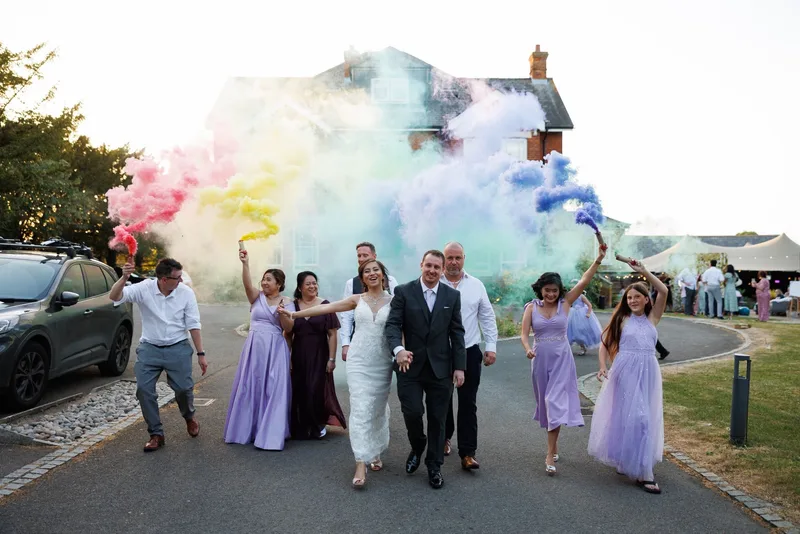
At a teepee wedding near Cambridge on a properly hot day, I dropped several booked items, including the DJ battle, because guests wanted shade, food and the lawn more than the dancefloor. The couple never noticed. It shows that a wedding MC's real job is judging what the day needs, even when that means cutting from the plan.
What Happened at This Teepee Wedding?
Yesterday I was the MC at a wedding in a teepee at The Lodge, just outside Cambridge. It was a properly hot day, the kind England barely sees. The couple were lovely. Their friends and family were genuinely pleasant. The team running the venue knew exactly what they were doing. There was nothing about the day that could have gone better.
By any honest measure, it was a brilliant wedding. The couple said as much when they came to find me at the end. The reason it worked was largely because of the items I quietly took off the plan, not the ones I delivered. That's what I want to write about.
That's the part of being a wedding MC that's hard to put in a brochure. The job isn't to execute the booked list. The job is to read what the day actually needs, in the moment, and adjust. Sometimes that means doing more than you signed up for. Sometimes, like yesterday, it means doing less.
What I Was Booked to Do
This couple had booked me for the full day. Alongside the music, that included:
- The Love Story, where I narrate how they met
- Wedding party introductions
- The Mr and Mrs game
- A DJ battle
- Marriage proposals (a moment in the evening where guests share heartfelt or funny vows)
- Wisdom cards (guest messages read out at the right point in the evening)
- A party pack of props and extras for the dancefloor
That's a packed sheet. I'd prepared for all of it. The Mr and Mrs game alone takes time to script properly so it lands. The DJ battle music is a deliberate selection that takes me about an hour to put together. By the end of the night, several of those items hadn't happened, and the couple didn't know which ones.
How Does Hot Weather Change a Wedding?
The weather changes everything. People often underestimate by how much.
When it's hot in England, and especially when it's rare, guests don't behave the way they do at an average wedding. They go outside. They stand in the shade. They want fresh air and a cold drink in their hand, not a packed room and a beat. Lethargy creeps in. The dance space sits half empty for long stretches because half the wedding is on the lawn.
The teepee itself was actually cool inside. That wasn't the problem. The outside was just nicer, and guests gravitate to whichever space feels best on the day.
The couple had hoped the first dance would happen around 7:15. By 8 it was obvious that wasn't going to work. The energy in the room wasn't there. Nobody was edging towards the dance space. When I announced the buffet, a hog roast, a queue formed instantly, the kind of queue you only see when guests are properly hungry and slightly drained. They wanted food more than they wanted music. That's a signal.
On top of that, there was a hard 10:30 finish, with the last half hour at reduced volume because the venue is near houses. That gave me a small window of real dancing time, sandwiched into a day where the room kept emptying out to the garden.
Why Did I Drop the DJ Battle?
A DJ battle only works when the room is packed and the energy is up. You need a critical mass of guests, and you need that buzz where everyone's egging each other on. It's a high-energy crowd moment. With half the wedding outside and the dancing window already shrinking, there wasn't a slot where a DJ battle would have landed. So I didn't do it.
I'd prepared it. I'd cued the music. I'd thought about how to set it up. None of that was wasted in any way that matters, because the alternative would have been forcing a moment the room didn't want and watching it fall flat.
The job isn't to use everything I've prepared. The job is to use what fits.
When the couple came to thank me at the end of the night, they didn't mention the DJ battle. They genuinely hadn't noticed it didn't happen. The groom said something to me along the lines of: "It's good that you just let the day flow rather than forcing things in because they were booked." That was the day, exactly.
What Are You Really Paying a Wedding MC For?
You're paying for someone you trust to make the calls on your behalf, and the groom's comment showed exactly that. He and his now-wife had paid me to host their day. They could have paid me to run through a checklist. They didn't. They paid me to use my judgment, in the moment, on their behalf.
The list of items they booked wasn't really the product. The product was a person who can read what's happening, work out what would help most, and do that. The list was a starting point. The judgment was the actual service.
That's a real shift in how to think about hiring a wedding MC. Couples sometimes want a guarantee of every booked item, and I understand the instinct. But it's the wrong thing to optimise for. The better question is: do you trust this person to make the calls on your day? If yes, the booked list is a guide. If no, you've booked the wrong person.
What Does It Mean to Read the Venue, Not Just the Room?
People talk about a wedding MC "reading the room", and they're right. What gets less attention is reading the venue, by which I mean the physical environment. Where are people drifting to? Where's the shade? Is the bar near the dancefloor or on the other side of the garden? Are children running around the marquee, or settled near their parents?
Yesterday, the venue was cool inside the teepee but cooler outside, with shade and a breeze. The room emptied out for that reason. No emotional or social signal involved, just physics. If I'd been only reading the social energy, I'd have been confused. Once I clocked that it was a venue-and-weather story, the right calls became obvious.
That's part of why I walk a venue the moment I arrive. I want to know where the heat sits, where the light is, where people will naturally gather. The physical map of the day shapes everything else.
Will You Notice If Something Gets Dropped on the Day?
Wedding days are a sensory overload for the people getting married. From the moment they arrive to the moment they leave, somebody is talking to them, hugging them, asking them a question, offering a drink, or wanting a photo. They almost never get five quiet seconds. They are not, in any practical sense, monitoring whether item 4 on the schedule happened on time.
This is why couples don't notice when a booked element gets dropped, if the dropping was the right call. They're inside the day. They're feeling it, not auditing it. What they remember afterwards is the texture: was it warm, did it flow, did our people have a good time. That's it.
So when you book an MC, you want someone making the on-the-day calls so you can be fully in your wedding instead of running it. I've written more about the invisible work of an MC elsewhere. Most of the time, when an MC looks like they're doing nothing, that's actually the sign of a day running well.
Is Less Dancing a Sign of a Worse Wedding?
No: less dancing isn't less of a wedding. There's a tendency to measure a wedding by dancefloor hours. Did people dance for four hours? Was the floor packed? That's a useful metric, but it isn't the only one, and it wasn't the metric to use on a day like yesterday.
Yesterday's couple loved their wedding. Their guests loved it. The food was excellent. The conversation flowed. The teepee, the lawn, the speeches, the laughter, the proposals shared in the evening, all of that was the wedding. The dancing was a piece, and a smaller piece than usual, because the day didn't want more of it. That doesn't make it a worse wedding. It makes it the wedding that happened.
What Should You Plan for at an Outdoor or Summer Wedding?
A few things worth knowing if your wedding will be at an outdoor venue, in a marquee or teepee, or simply on a date when the weather could be properly hot:
- Build buffer into the timeline. First dances often slip by an hour or more when it's hot. Pad your evening rather than trying to enforce a fixed start.
- Plan food slightly earlier than feels right. Appetite peaks before energy does. Hungry guests aren't dancing guests.
- Accept that less dancing isn't a sign of failure. If half your wedding spends the evening on the lawn laughing, that's a good wedding.
- Book vendors who'll adapt, not just deliver. Anyone can run a fixed plan. The question is what happens when the day doesn't go to that plan.
- Trust your MC's read of the room on the day. If they suggest dropping or reshuffling something, that's usually their judgment doing the job you paid for.
The Takeaway
Yesterday's wedding was a success, not despite the changes I made on the fly, but because of them. The couple got the day they actually wanted, which isn't always the day they wrote on a piece of paper six months earlier. They got it because they'd hired someone whose job was to read the day and respond, not to tick items off a list.
If you'd like an MC who'll do that for your wedding, I'd love to hear about your day.