
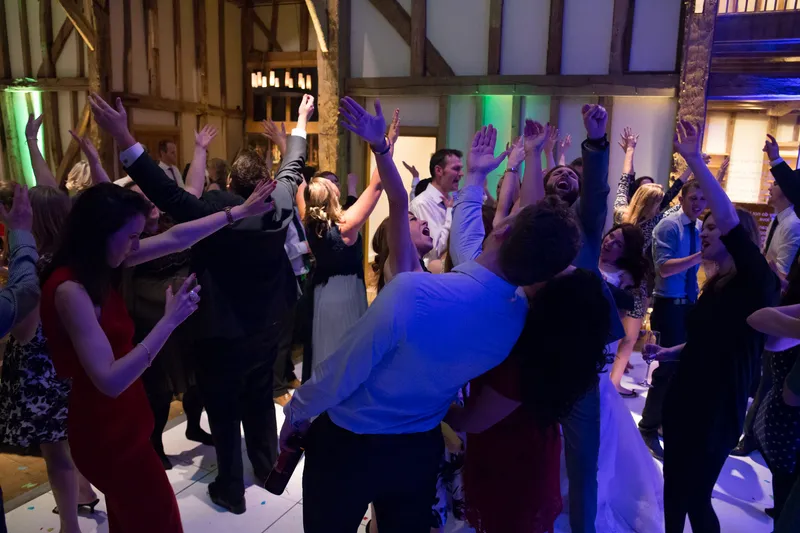
When a venue makes the DJ turn the music down late in the evening, the dance floor usually thins within half an hour. Quieter music loses its bass first, and bass is what makes people want to move. If your venue turns the volume down at a set time, put the big moments before it, tell your guests in advance, and think about ending the music at that point rather than fading into background music.
Most venues with a late-night volume rule mention it when you book, and most couples don't give it much thought, because 11pm feels a long way off when you're looking round an empty room in the daytime. I've seen what that rule does to the end of a wedding many times, and I saw it again at a wedding I played this October.
What happened when the volume came down at 11pm?
It was a lovely, unconventional wedding with a warm atmosphere all day. There was no sit-down meal: pizzas kept coming out through the afternoon and again in the evening. The only speeches were from the couple themselves, standing, and the groom's was emotional and went down brilliantly. The guests were English and Irish, and once the dancing started they wanted 80s soul, Irish music and 90s dance music, with some indie and UK garage along the way.
Between 8 and 11 the dance floor was full for long stretches. The crowd were going wild; it was one of those exuberant nights where the room carries itself.
The venue's rule was that the volume came down at 11. I started bringing it down at about 10:52 and spread the change over eight minutes, a couple of songs' worth, so nobody would feel a sudden drop. Within half an hour, the dance floor held about a quarter of the people it had held all evening.
Other things played a part. It was getting late, the weather was dreadful and people were booking taxis. Some of the floor would have drifted away anyway. But I've watched the same pattern at many weddings and events: when the volume goes down, the dancing goes down with it.
Why does quieter music stop people dancing?
It's tempting to assume a quieter version of the same song does the same job. Several pieces of research suggest it doesn't.
You feel dance music as much as you hear it. In 2022, researchers at McMaster University in Canada ran a live electronic music concert and switched very low bass on and off through the speakers. The audience wore motion sensors. When the low bass was on, people moved about 12% more, even though they couldn't tell it had changed. The researchers think the body picks it up through vibration and the balance system in the inner ear, rather than through hearing.
That matches what I see from the decks. Plenty of guests need to feel the music before they'll dance. Not painfully loud, but loud enough for the bass to land.
Turning the music down takes the bass away first. Our ears don't hear every frequency equally at every volume, something sound scientists have measured since the 1930s. At lower volumes we lose sensitivity to bass much faster than to vocals. So when the music comes down, your guests aren't hearing a quieter version of the same song. They're hearing the singer and the top end, with most of the part that got them moving gone.
The urge to move lives in the bass. Studies of "groove" (the pull you feel to move to a track) point the same way. A 2016 study found that changing the overall volume made little difference to how groovy people found a track, while a deeper bass line made a clear one. A 2024 study of house music found groove was weakest whenever the low end was weak, however rhythmic the track. A moderate volume can still fill a floor if the bass survives. A limit that strips the bass out is what empties it.
Quiet music makes conversation the easy option again. A French study in 2008 turned the music up and down in two bars. When it was louder, people ordered more drinks and drank them faster, and the researchers' explanation was that loud music makes talking harder, so people do something else instead. On a dance floor it works in reverse. Once the music drops to the level of normal conversation, chatting becomes easier than dancing, and small groups drift off to the edges to talk.
There's a social side as well, though this is my observation rather than something I've seen tested. A loud, full floor lets people lose themselves in the crowd. When the music drops, the dancers who are left feel more on show, and the more self-conscious ones sit down first. Once a few go, others follow.
"We had people on the dance floor all evening, and the volume was perfect - loud enough for people to relax and enjoy themselves, but not so loud to hurt your ears and prevent talking."
-- Faye & Will
Why do guests blame the DJ when the music goes down?
You'll have been told about the volume rule when you booked the venue. Your guests almost certainly weren't. So at 11pm, from where a guest is standing, the DJ has turned the party down for no reason.
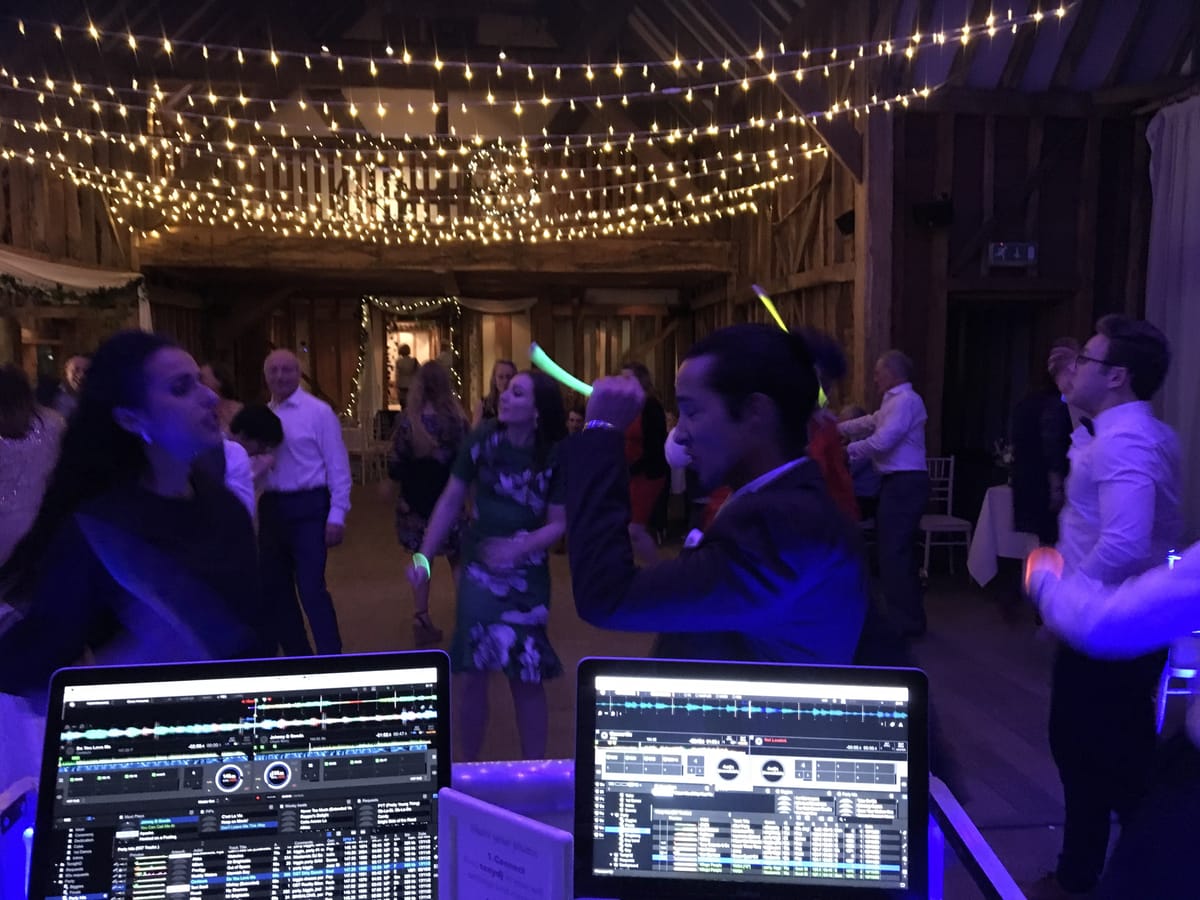
I've played a venue in Richmond several times where the music has to drop to background level at 11, and the couples have always known about it because the venue tells them when they book. Their guests don't know, so for most of the last hour I have a steady stream of people coming over to the decks to ask if I can turn it back up, and I have to keep explaining that I can't.
By then most of them have been drinking for several hours and have just come off a couple of hours of dancing, and after that much alcohol people don't take in a reason the way they would earlier in the evening. Telling someone the venue has a noise rule doesn't get very far when they've had a few drinks and want the party back, so they get annoyed, and the person they get annoyed with is usually me.
Why can stopping the music be better than fading out?
Guests remember an evening mainly by its best moment and by how it ended, which psychologists call the peak-end effect. I've written more about it in The Peak-End Effect: Why Your Last 30 Minutes Matter. Three brilliant hours followed by an hour of background music leaves your guests with a flat ending to remember, however good the rest of the night was.
Picture it from the dance floor. You've been dancing for two or three hours, you've had a few drinks, your heart's still going. Background music at that point lands as an anticlimax, as if the party has been switched off while you're still in the middle of it.
So if your venue cuts the volume hard, think seriously about ending the music at that high point. Build to one big final song, get everyone on the floor for it, and finish while the room is full. That last song is what your guests take home with them.
"Tony made our wedding day a great success, we had a great day and it was really well finished with some top quality dj'ing, we had so many positive comments."
-- Megan & Dean
What should you ask your venue about volume before you book?
Most late-night volume rules come from the venue's licence or planning conditions, usually to protect neighbours, and barns and converted buildings near houses tend to have the strictest. My guide to sound limiters at wedding venues explains how they work.
- What time does the volume have to come down, and is it a gradual fade or a hard stop?
- How far does it come down? "A bit quieter" and "background music only" are very different evenings. Ask for the decibel figure. For a sense of scale, barn conversions often limit music to around 85 to 90dB, and hotels and purpose-built function rooms usually allow 95 to 100dB. Background music sits well below both.
- Is it in the contract, and is it enforced by a sound limiter? More on limiters in Venue Restrictions and Sound Limiters: What to Ask.
- Is it worth paying for the time after 11? An extra hour of background music can cost you the best possible ending to your night.
How can you plan your evening around the volume change?
- Tell your guests the finish time in advance. Put it on your wedding website or invitation, or ask whoever does the speeches to mention it. People take a rule much better when they knew about it beforehand.
- Put the big moments before the volume comes down. Your last dance, the songs everyone's been waiting for, the final circle on the dance floor. Plan the evening so the peak and the ending come together just before the volume comes down.
- Agree with your DJ that finishing when the volume comes down is an option. Then it can be decided on the night by how the room feels, rather than by what the booking form says. With me, it makes no difference to the fee: what you pay depends on the package, all day or evening, not on what time the music stops.
- If you carry on after the volume comes down, change the music to suit it. Singalongs and vocal-led songs hold up at a lower level far better than tracks that rely on the bass. That's what I switch to when a venue's rule kicks in. If you're wondering about a silent disco for that last hour, I've answered that in my sound limiter FAQs.
How should a DJ bring the volume down?
Gradually, and early. I start several minutes before the deadline and spread the change across a couple of songs, so the room barely notices it happening. An inexperienced DJ tends to drop the volume at 11 on the dot, and then everyone notices at once, which is the worst way for your guests to find out about the rule.
I don't make an announcement about it on the mic either. There's nothing positive to say about the party getting quieter, and drawing attention to it only makes the change more noticeable.
Planning a wedding at a venue with a volume rule?
If your venue turns the volume down late in the evening or has an early finish, tell me about it when we first talk. We'll plan the evening so it peaks before the volume comes down, and your guests go home remembering the best part of the night.
The research mentioned in this post
- Cameron and others (2022), Current Biology: very low bass increased dancing at a live concert. Summary from Technology Networks
- Equal-loudness contours (ISO 226), how our hearing of bass changes with volume. Overview on Wikipedia
- Stupacher, Hove and Janata (2016), Music Perception: bass frequency, loudness and groove. Paper
- Duncan and Orgs (2024), Music Perception: low-frequency level, syncopation and groove in house music. Summary
- Guéguen and others (2008), Alcoholism: Clinical & Experimental Research: music volume and drinking in bars. Report from NBC News